O’Donnell
INCO Triangle Aritcle October 1974
O’Donnell the little village that was
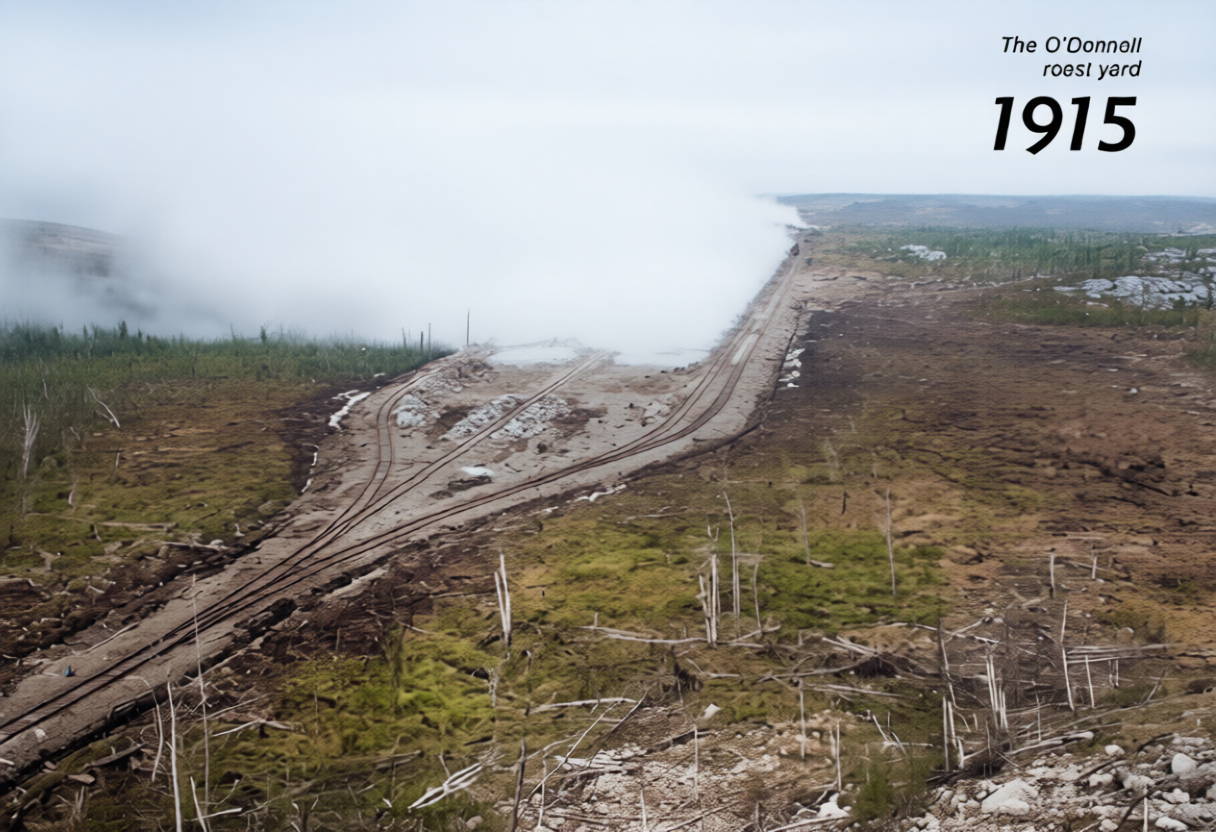
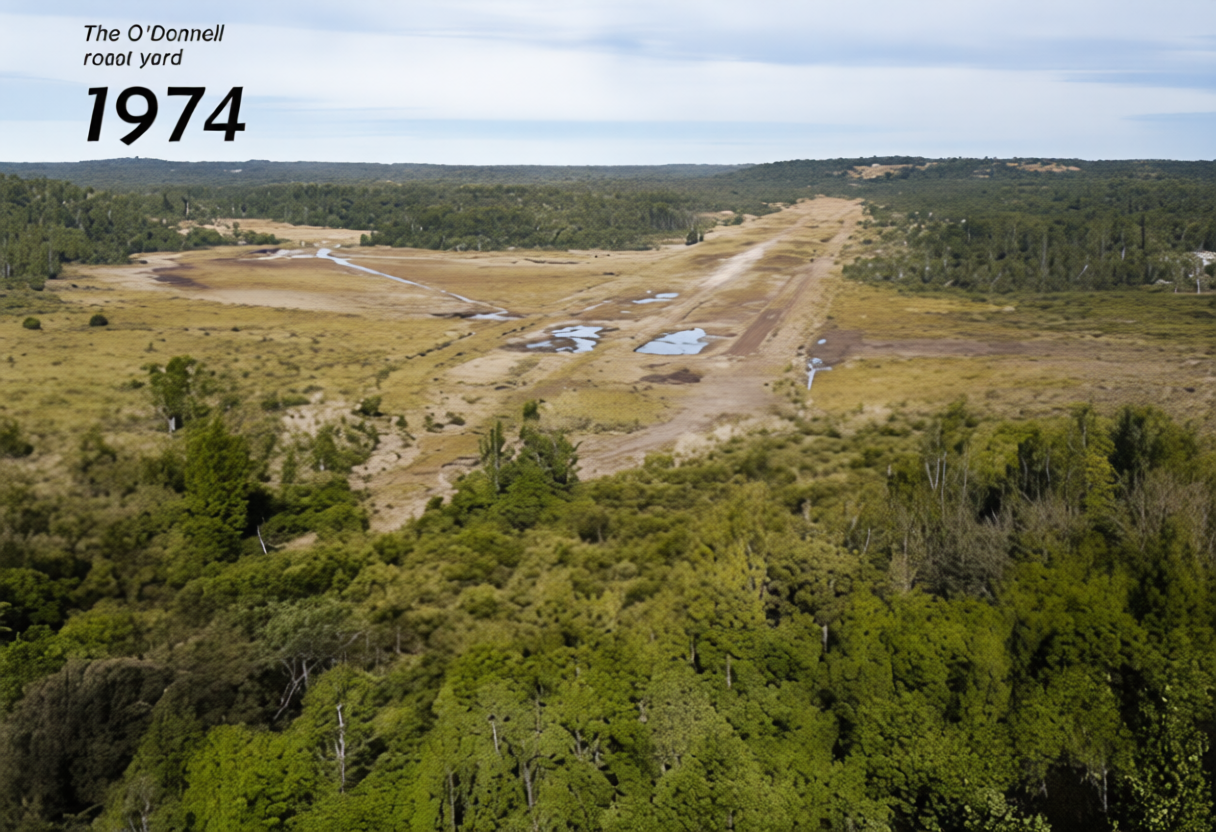
Back in the ’20’s, a tiny village nestled in the bushland southwest of Creighton mine.
It was called O’Donnell, and during its short lifetime, no more than 20 families lived there at one time.
Born in 1915, it was abandoned a decade and a half later when its residents moved on in the name of progress. But even though O’Donnell no longer exists, it lives on in the hearts of many who remember it as home – the place where they grew up.
About four and a half miles west of Creighton on the Algoma Eastern Railway line, the village grew beside the O’Donnell roast yard, established in 1915 by the Canadian Copper Co. It was hoped that the chosen isolated area would minimize sulphur smoke damage in the Copper Cliff area. And so began O’Donnell.
It was mid-December of 1920 when Bob Bryson, now a senior industrial engineer for Inco in Copper Cliff, arrived in O’Donnell. He was five years old and his father, Bob Sr., had just transferred from Inco’s transportation department at the Copper Cliff smelter to the O’Donnell roast yard. Bob’s father was to operate the steam shovel which picked up the roasted ore from the beds and loaded it into railway cars destined for Copper Cliff.
It was dark when Bob Sr., his wife Florence, Bob and his brother Andy drove into the village in their model “T”, a team of horses following behind with their furniture on a sleigh. It was morning before they saw the village which would be their home for the next 10 years.
O’Donnell, as Bob remembers it, consisted of frame houses – one of which Bob’s father claimed – and a larger boarding house, operated by George Dunsmore, to accommodate single men. A general store provided work clothes and necessary supplies. The school was a one-room building which doubled as a church and there was a sort of community hall. A rustic shack passed for the train station where mail was dropped off each day. And, since indoor plumbing was restricted to the boarding house and a few of the larger houses, most of the new residents made do with “three rooms and a path”.
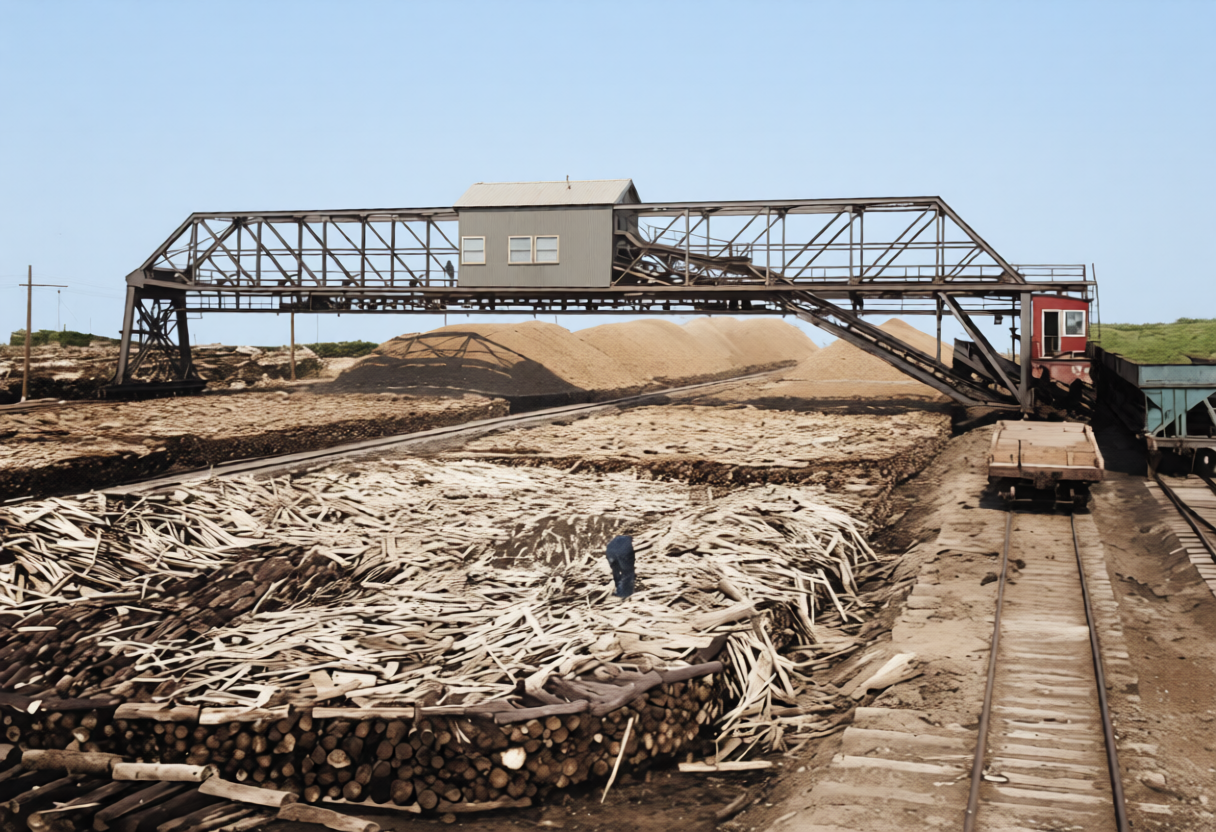
The roast yard was a sight to behold. Individual roast beds, 100 feet long and 60 feet wide, extended in two rows, each about a mile and a quarter long. Ore was piled up to eight feet high on top of cordwood stacked five feet high and, as it burned, dense white clouds of sulphur smoke rolled off the mounds. The smoke had already taken its toll on vegetation for miles around.
Unfortunately, the townsite was on the prevailing downwind side of the roast yard, so residents of O’Donnell lived in a perpetual cloud of smoke. Recalls Bob: “There were days when I couldn’t see my hand in front of my face and I’m not kidding when I say I got lost one day walking the 50 yards to school. Needless to say we had no gardens – there wasn’t as much as a blade of grass growing in the village.”
The townsfolk got used to it though, and it was rumoured that maybe the sulphur smoke wasn’t all that bad. There was neither doctor nor dentist in town and, curiously enough, a doctor was seldom needed. Bob remembers a Dr. Boyce from Creighton who visited O’Donnell on occasion. “He used to say we were the healthiest bunch he’d ever seen,” chuckles Bob. “Guess that smoke prevented the germs from germinating.”
Bob claims when people first saw O’Donnell, they always said they weren’t going to stay. But they always did, because, in spite of its drawbacks, O’Donnell was special.
“I’ve never seen spirit anywhere like there was in that little community,” remembers Bob. “We had to develop an ability of getting along with each other. There wasn’t enough room in town for fighting with our neighbours. The people made the difference.”
Everyone attended church in the school house, regardless of denomination. Rev. Manuel and later Rev. Mitchell conducted the weekly church service on a week night, since they were too busy in their own church in Creighton on Sundays.
The general store closed after a couple of years, but Sam Fera took care of the townspeople. By horse and wagon and later by model “T”, “Old Sam” brought groceries from Creighton to the people of O’Donnell. Clothes and other necessities were obtained by mail order through the Eatons catalogue.
“Growing up in that village, all we knew was the company,” says Bob. Many who went to school together in O’Donnell ended up working for Inco; in fact, Bob’s three brothers, two of them born in O’Donnell, also work for Inco – Andy is a paymaster in Port Colborne, Jim is in the laboratory at the Copper Cliff copper refinery and Star is in the machine shop at Copper Cliff. The four brothers have a combined service to Inco of 145 years, and Bob believes it has a lot to do with their years in O’Donnell.
But, it was not all work in O’Donnell.
When it came to entertainment, the citizens of O’Donnell were resourceful enough to provide their own. There was an outdoor rink for hockey and there was always a ball field in the Bryson yard, even though there were never enough kids for two teams. The swimming hole was the creek that supplied the water for the village.
Children of high school age generally boarded away from home, but even when Bob started high school in Sudbury in 1929, he found it difficult to leave O’Donnell. For a while he boarded in Coniston, but for the last few months of his first year, he commuted the 16 miles each way every day, nine miles by bicycle and the rest by bus.
During his second year of high school, Bob boarded in Sudbury, but came home every weekend, always walking the distance between Creighton and O’Donnell.
In 1930, some of the families started moving out of O’Donnell and by June of 1931, the Brysons had moved to Sudbury. Construction of a new smelter at Copper Cliff had put the roast yard and the village out of business.
O’Donnell was deserted. The buildings crumbled, the railroad was shut down, Mother Nature replaced the burned vegetation and the townsite disappeared. Only the scar of the roast yard and a few concrete basement walls remain today . . . along with a lot of pleasant memories.
Whenever former O’Donnell residents meet, the conversation always centres around that little community. They tell the true story of a Scottish fellow named Joe MacArthur who brought his new bride from Scotland to live in O’Donnell. As they were approaching the sparsely vegetated townsite, the bride timidly questioned: “But how do they grow those rose beds you were talking about?” Joe retorted, “not rose beds my dear- I said roast beds.”
Picture text
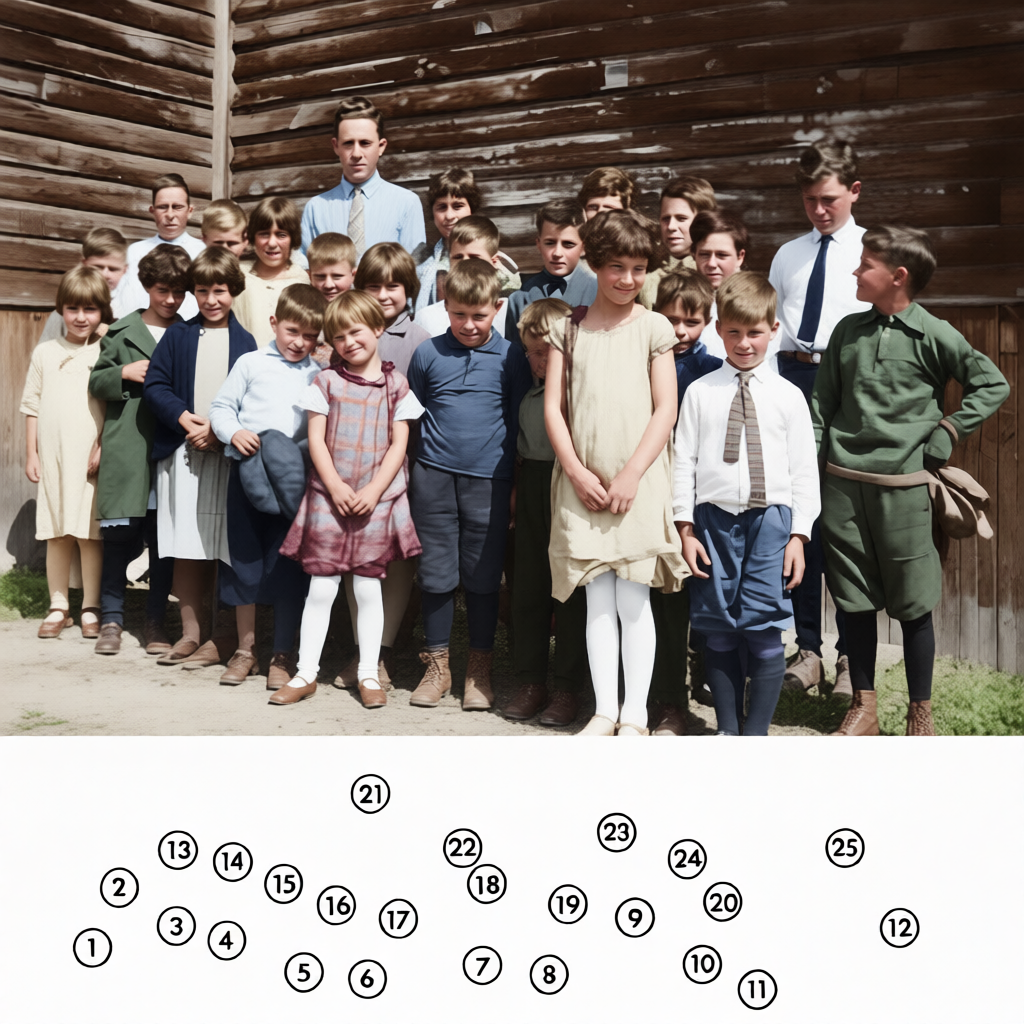
The class of ’26 outside their one-room schoolhouse in O’Donnell. Those identified are: 2. Don Bray, Inco fire marshall; 5. Alcide Denomme; 7. Art Lalonde; 8. Bill Lalonde; Evelyn Hildebrant; 11. Bud Germa, Inco and in the Ontario legislature; 12. Andy Bryson, paymaster at the Port Colborne nickel refinery; 13. Alvin Bray, Inco pensioner’ 14. Larry Lalonde; 15. Leo Lalonde; 19. Bob Bryson, Copper Cliff industrial engineer; 20. Evelyn Germa (Fox), Copper Cliff copper refinery; 24. Allan Hildebrant, Inco pensioner; 25. Clyde Dunsmore, Inco pensioner.
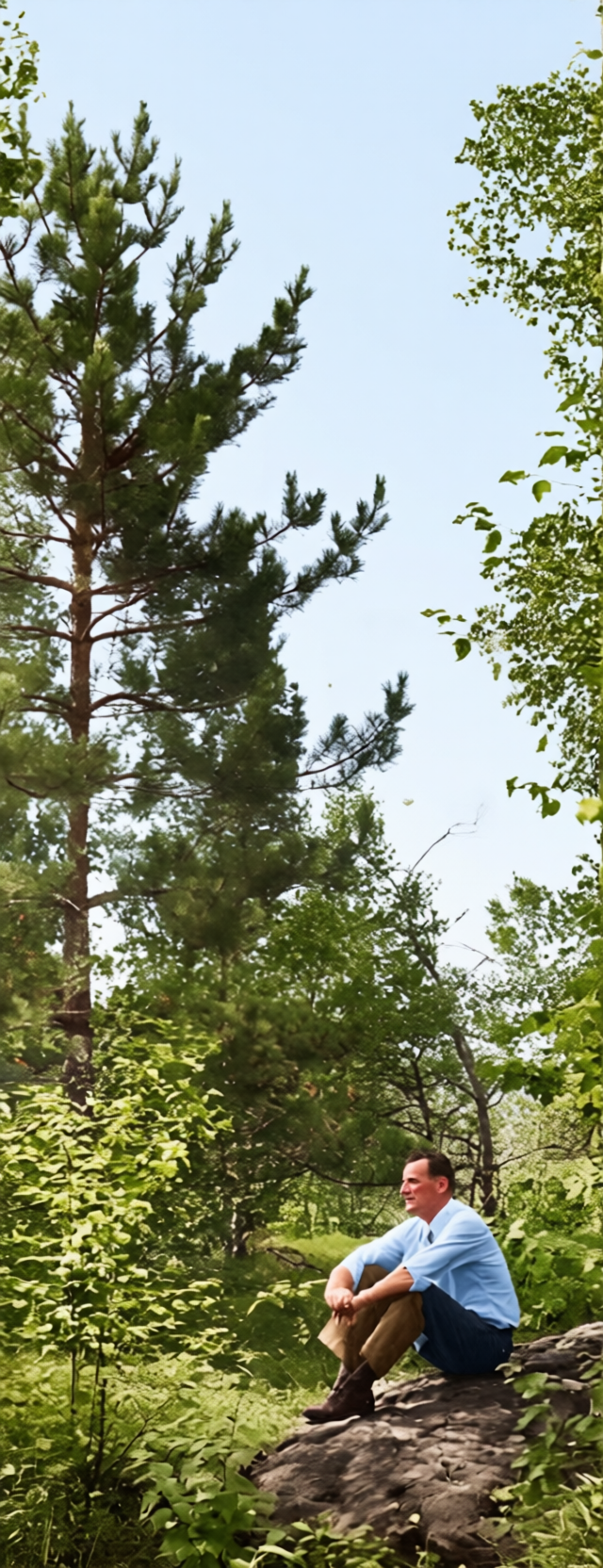
The valuable source of information for this article, Bob Bryson, is overshadowed by the pine that has grown on the site of the house at O’Donnell where he grew up. When he left in 1931, there was not a blade of grass growing in the village.
Individual roast beds were 100 feet long by 60 feet wide. With a clear span of 170 feet, the travelling green ore unloading bridge serviced the mile and a quarter long roast yard. On the average, a bed burned for seven to eight months.
Taken From – There Were No Strangers – The History Of The Village of Creighton Mine By The Andersen Farm Museum
O’Donnell
The Village of O’Donnell could be called Creighton’s little sister. The town took its name from the roast beds which were the reason for its existence. The roast beds were named for Mr. John O’Donnell who worked for INCO until 1922.
The roast beds were established in 1915 in an effort to minimize sulfur smoke damage in the Copper Cliff area. The following history has been written by Mr. Don Bray, retired INCO Fire Marshall.
Another O’Donnell resident, Mr. Bob Bryson, remembered his ten years in O’Donnell, from 1920 to 1930, in the INCO Triangle. He recalled that Doctor Boyce from Creighton visited occasionally and said that the residents of O’Donnell “were the healthiest bunch he’d ever seen.” Dr. Boyce speculated that the sulfur may not have been as bad as some people thought. A good thing considering the village had neither dentist nor doctor.
O’Donnell is remembered by Boyce as having a special spirit where everyone got along. “There wasn’t enough room in Town for fighting with our neighbours.”
The community depended on week-day. visits from Rev. Manuel and later Rev. Mitchell from Creighton for spiritual guidance.
Although there were never enough children in O’Donnell for two baseball teams, Mr. Bryson remembers good times. There was a ball field in his family’s yard, an outdoor rink for hockey, and swimming in the creek.
O’Donnell had close ties with Creighton and we would be in error if we failed to include some of its history here.
O’DONNELL REMEMBERED
By Mr. Don Bray
The village of O’Donnell consisting of approximately thirty families developed beside the Roast Yard in 1915 and was 4 miles west of Creighton on the Algoma Eastern Railway. The Roast Yard replaced the one that had been in Copper Cliff. Originally, there had been approximately 200 employees, but after the travelling Ore Bridge was built in 1918, this number was reduced to 40. The ore beds were built initiallyby laborers using wheel barrows to remove the Creighton green ore from flat cars. This extra manpower was no longer required once the Bridge was put into operation.
The Roast Yard was 1 miles long with two rows of beds which were 100 feet long by 60 feet wide. Green ore was piled up to eight feet high on top of cord wood stacked four feet high and as it burned for six to eight months, dense white clouds of sulphur smoke eradicated the vegetation for miles around.
In the village, besides the homes, was a one-room school, town hall, general store, post office (in one of the homes), ice house, rink, train station (shed), dry and a club house, mainly for single men, operated by George Dunsmore. The store closed after a few years when Sam Fera took over from their Creighton store, first with a horse and wagon and later with a Model “T” truck.
We moved from Copper Cliff to O’Donnell in the winter of 1916 when operations first began. I was six months old at the time. We moved back to Copper Cliff on September 22, 1930 when operations ceased as the Roasters in the new Copper Cliff Smelter replaced the outdoor roast beds.
My mother was raised in Creighton having arrived there in 1901 from a farm in Perth, Ontario, with her parents, Mr. and Mrs. Donald McDonald, one sister and two brothers. She was six years old at the time and began her education in the public school, which ended after two years in the Sudbury High School. Their home was at 21 George Street, next to Kelly’s Store. The family moved to Copper Cliff in 1913 when her father was transferred to #2 Mine. After the death of Mrs. McDonald in 1915, he returned to Creighton where he retired from the Mine in 1931.
During its history O’Donnell was shut down twice for approximately a year each time, first in 1919 when we moved back to Copper Cliff and again in 1921 when we moved to Creighton, where we lived at 5 George Street. Here I began school in a renovated boarding house up the hill from Kelly’s Store. This was a temporary situation as the school house had burned down and a new one was in the process of being rebuilt. My father stayed in O’Donnell as the watchman during this period.
The INCO supervisory staff during operations consisted of Bob Richardson, Superintendent; Bert Bray, Master Mechanic; Percy Coombs, Operations Foreman; Mose Fior, Track Foreman, and Jack McPhail, Timekeeper.
Teachers in the school at various times that I can recall were Mr. Lang, Mr. Davidson, Barbara Mitchell (later to become Mrs. Bill Boyle), Miss Pickering, and Harry Cooper.
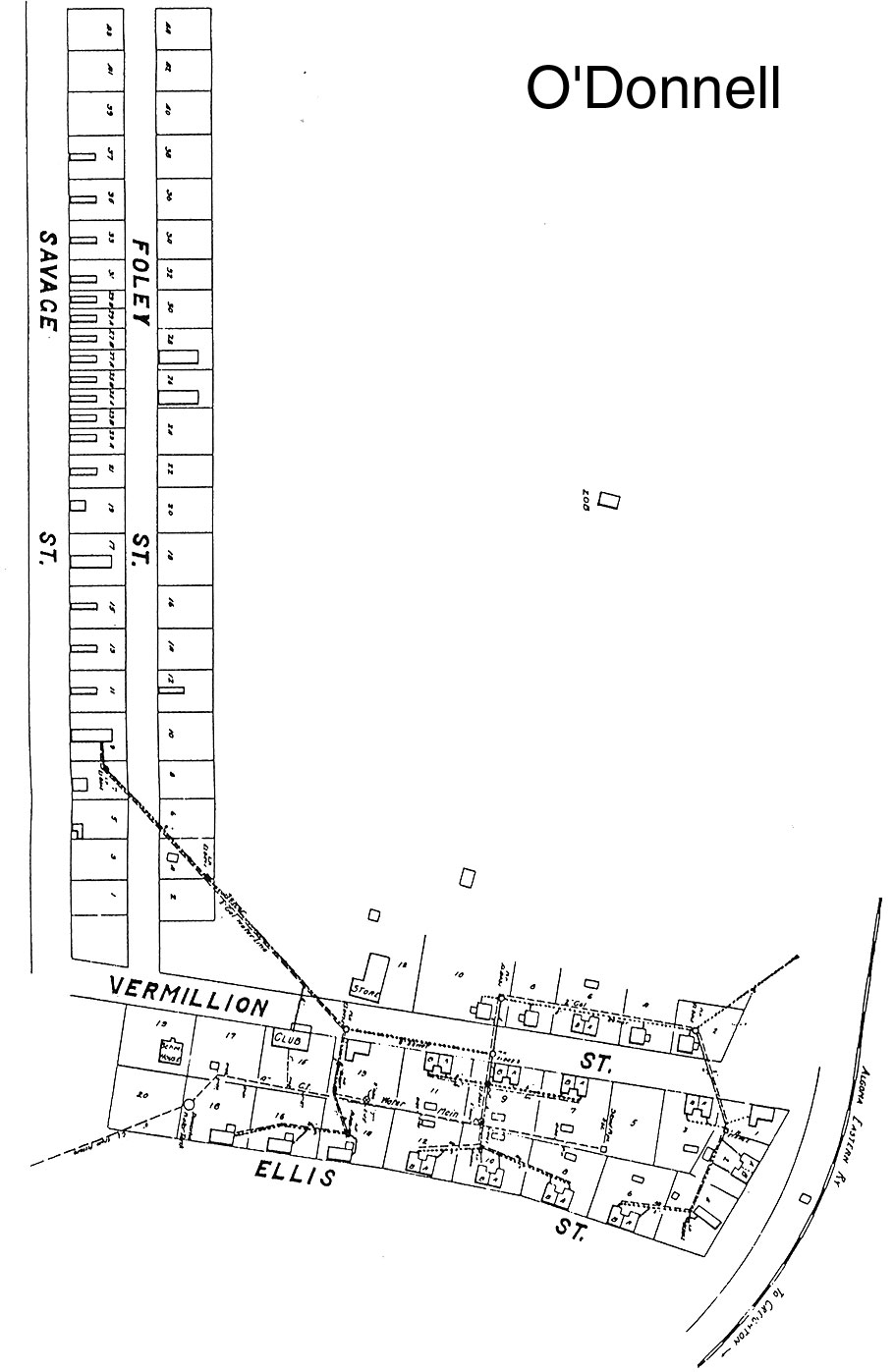
The addresses from #21-37 on Savage Street were mainly railway box cars that were used as homes for the extra men that were required before the Ore Bridge was built. Most remained empty afterconstruction was completed. This was also the case for the two boarding houses on Foley Street.
In conclusion, I must say I have only fond memories of O’Donnell, especially as it was there my younger brother, Ian, and two sisters, Joyce and Noreen, were born. Also, it was at O’Donnel where my older brother Alvin began work in 1929 before working in the Rock House in Creighton and then to Copper Cliff.
Please see attached Plot Plan RC201G and list of tenants.
ELLIS STREET
2A – J.Bedesky
- – A. Dion
- – J. Cullen
6A. – J. McNeil
- – J. Powell
8A. – Vacant
- – Vacant
10A. – O. Lalonde
- – O. Lalonde
12A. – J. Germa
- – J. McArthur
- – R. Bryson
- – G. Hildebrant
- – J. Denomme
SAVAGE STREET
- – Staff House
- – A. Antonioni
9.-Dry
- – N. Cassidy
FOLEY STREET
- – Lepki Boarding House
28.
20B. – P. Savage
VERMILLION STREET
WEST SIDE
- – Bert Bray
- – J. Pakkala
6A. – Town Hall
B.
- – E. Lambert
- – R. Richardson
- – Store – Apt. W. Boyle
EAST SIDE
- – P.A. Germa
3A. – S. Butler
- – M. Fior
7A. – Tozer
- – G. Gauthier
9A. – D. Hamilton
- – G. Hamilton
11 A. – J. Sawicki
- – Jail – W. Wiggs
- – P. Coombs
- – Club House – G. Dunsmore
- – Public School